
The New Beauty Advertising Blueprint: Data, Dollars, and "Skintellectuals"
The beauty industry is no longer just about who has the glossiest magazine ad or the most famous face.
We are witnessing a fundamental shift—moving away from broad mass awareness and toward algorithmic precision.
Today’s market isn't just growing; it's evolving into a high-stakes, tech-integrated ecosystem where the consumer often knows as much about a formulation as the chemist who made it.
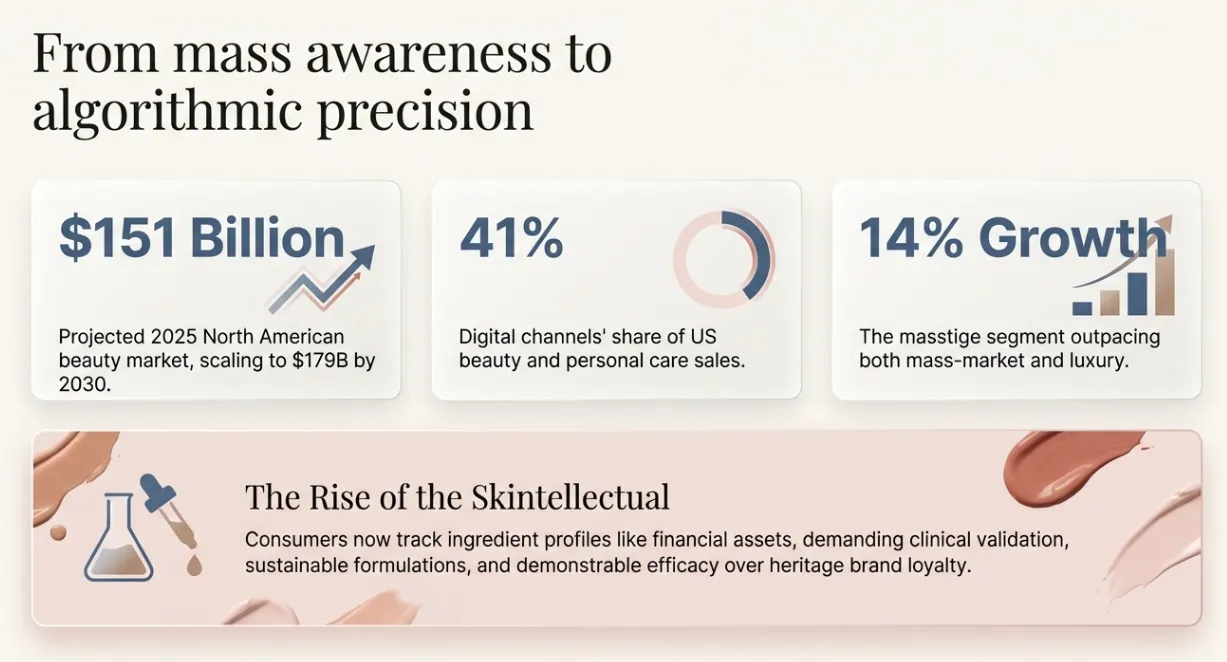
A $179B Horizon: The North American beauty market is projected to reach $151 billion in 2025, with a steady climb toward $179 billion by 2030. This isn't just steady growth; it’s a massive scaling of opportunity.
The Digital Dominance: Digital channels now command 41% of US beauty and personal care sales. If you aren't winning on the screen, you aren't winning the market.
The "Masstige" Sweet Spot: With 14% growth, the "masstige" segment (prestige-quality products at accessible prices) is currently outperforming both the entry-level mass market and the ultra-luxury tier. Consumers want high-end results without the high-end ego.
The Rise of the "Skintellectual"
Perhaps the most significant shift isn't in how much people are buying, but how they are buying. Enter the Skintellectual.
Gone are the days when a heritage brand name was enough to guarantee a sale. Today’s consumers track ingredient profiles with the same intensity a trader might track a stock portfolio. They aren't just looking for "moisturizer"; they are looking for clinical validation, sustainable sourcing, and demonstrable efficacy.
The Takeaway: For brands to survive this transition, "vibe-based" marketing is out. Transparency, science-backed claims, and precision targeting are the new table stakes.
Beyond the Funnel:
The Infinity Loop of Modern Growth
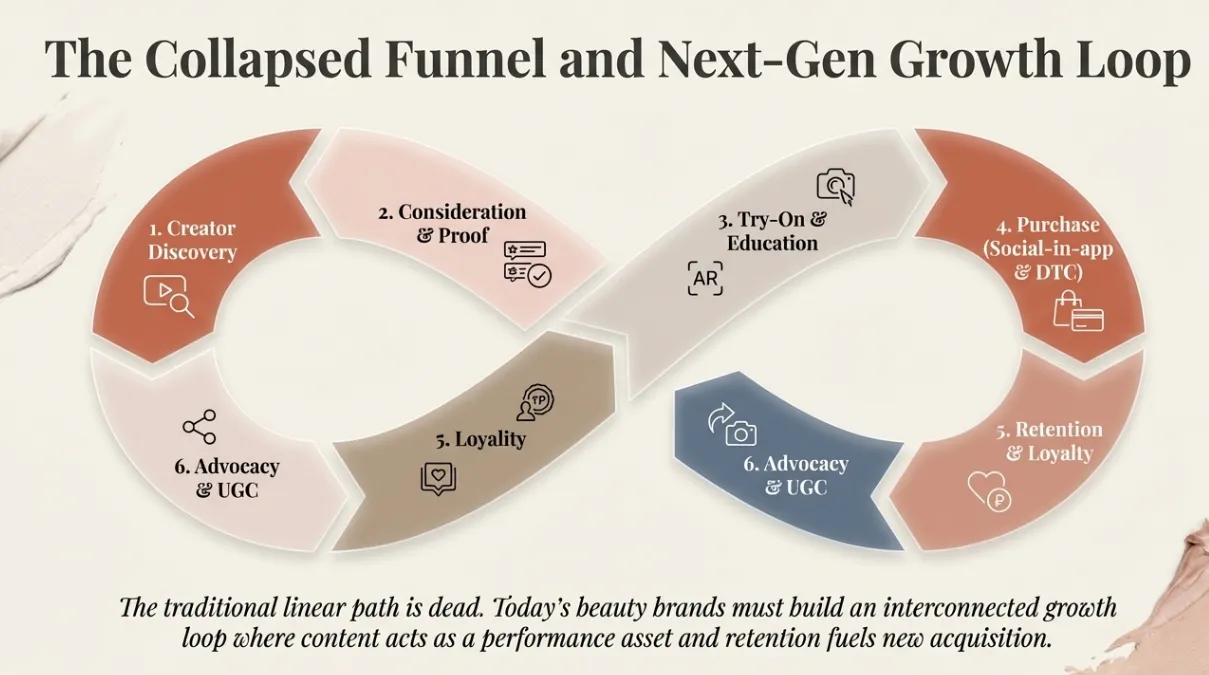
The linear path to purchase is dead. Today’s beauty brands must navigate a world where the moment of discovery is often the same moment as the purchase, and where a customer's review is more powerful than a brand's billboard.
This isn't a funnel; it’s an interconnected growth loop where every stage feeds the next in a perpetual cycle of momentum.
The Six Pillars of the Loop
To win in this "collapsed" environment, brands have to master six distinct yet overlapping phases:
1. Creator Discovery: It starts with a face, not a logo. Creators are the new storefronts, providing the first touchpoint of authentic awareness.
2. Consideration & Proof: The Skintellectual immediately looks for "receipts." They check comments, search for ingredient breakdowns, and look for social proof before moving forward.
3. Try-On & Education: Augmented Reality (AR) and digital education bridge the gap between "scrolling" and "knowing." This is where high-intent browsers turn into confident buyers.
4. The Frictionless Purchase: Whether it’s Social-in-app (TikTok Shop, Instagram Checkout) or DTC, the distance between "I want it" and "I bought it" has shrunk to a single tap.
5. Retention & Loyalty: The sale is just the beginning. Post-purchase engagement ensures the brand stays top-of-mind, turning a one-time buyer into a repeat customer.
6. Advocacy & UGC: This is the magic moment. When a customer creates their own content (User Generated Content), they feed back into the Creator Discovery phase for a new set of potential buyers.
Content as a Performance AssetIn this model, content isn't just "creative"—it's a performance asset. Every video, tutorial, and review serves as fuel for the loop.
The Shift: In the old world, you paid for reach. In the new world, you earn retention, and that retention is what fuels your next wave of acquisition.
By treating your customers as your best marketing department, you create a self-sustaining engine where the community does the heavy lifting of growth for you.
The Precision Profile: Decoding the Consumer
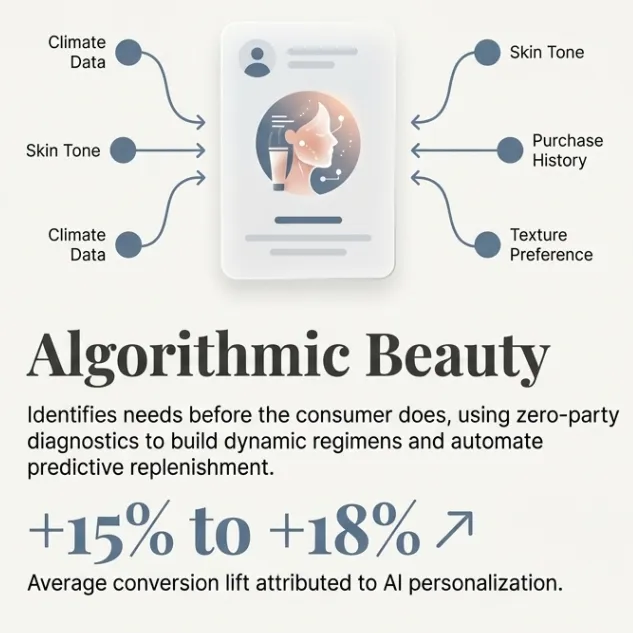
Modern AI doesn't just look at what a person bought; it looks at the why and the where. An algorithmic beauty profile synthesizes a range of variables to create a "digital twin" of the consumer's needs:
Climate & Environmental Data: Is it a humid summer in Miami or a dry winter in London? Algorithmic beauty adjusts recommendations based on the local zip code.
Biological Specifics: Precise skin tone matching and texture preferences ensure the product "fits" the consumer's physical reality.
Behavioral History: Purchase history isn't just a receipt; it’s a predictor for automated replenishment, ensuring the consumer never hits the bottom of the jar.
Winning with Zero-Party Data
In an era of increasing privacy concerns, the most successful brands are winning by asking, not tracking.
By using zero-party diagnostics—interactive quizzes or digital consultations where consumers voluntarily share their skin concerns—brands build a foundation of trust.
This high-intent data allows for dynamic regimens that evolve as the customer does, turning a one-time purchase into a lifelong habit.
The ROI of Intelligence
This isn't just "cool tech" for technology's sake—it's a massive driver of business performance.
The shift toward AI-driven personalization is yielding an average conversion lift of +15% to +18%.
The Credibility Gap: Why "Raw" Beats "Studio"
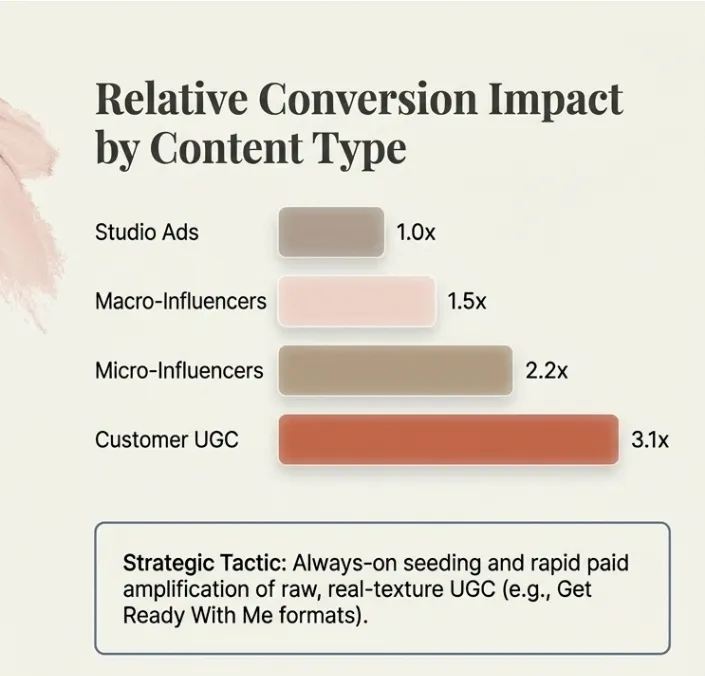
We’ve moved past the point where a high-budget studio production is the gold standard. In fact, when we look at Relative Conversion Impact, the hierarchy of influence has been completely flipped on its head. The Conversion Hierarchy:
Studio Ads (1.0x): While necessary for brand aesthetics and high-level awareness, traditional studio ads now serve as the baseline—the lowest impact on actual conversion.
Macro-Influencers (1.5x): High-reach celebrities and creators provide a significant lift, but their "perceived distance" from the average consumer limits their conversion power.
Micro-Influencers (2.2x): Here is where the needle really moves. The niche expertise and tight-knit communities of micro-influencers drive over double the conversion of a standard ad.
Customer UGC (3.1x): The undisputed champion. User-Generated Content (UGC) from everyday customers is 3 times more effective at closing a sale than a studio-produced ad.
Solving the 17.6% Friction:
From Hesitation to Confidence
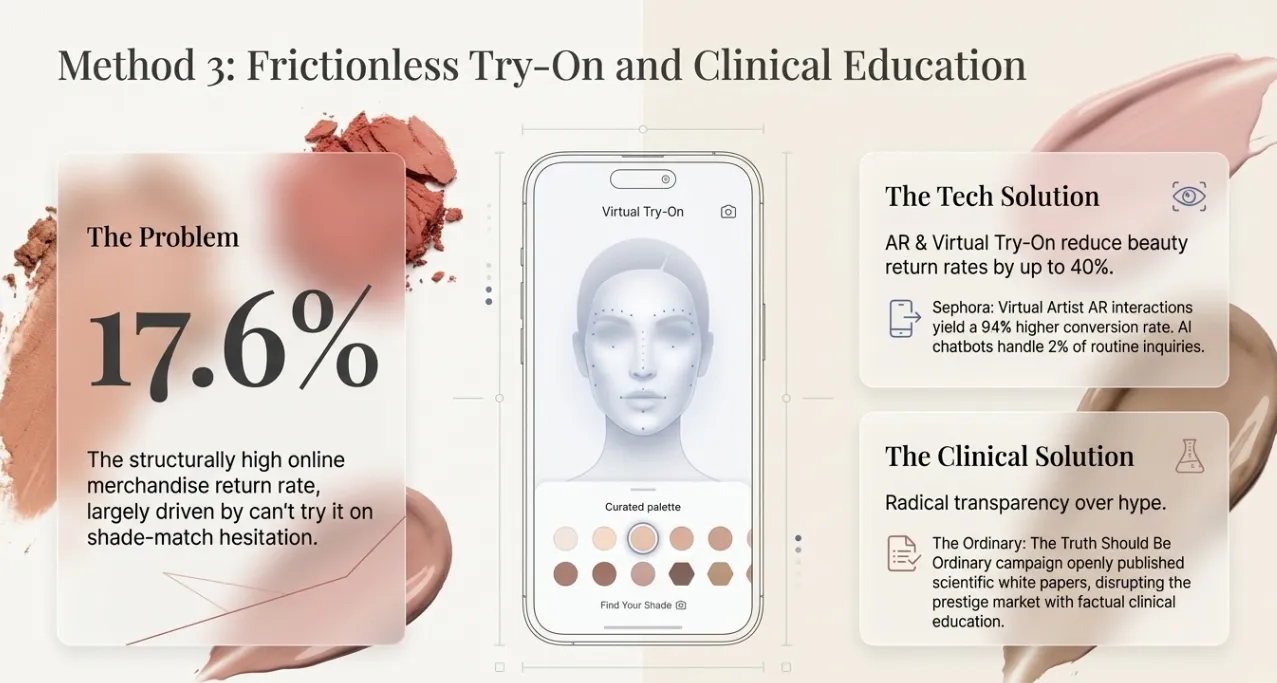
The biggest hurdle in e-commerce isn't just getting the click; it’s keeping the sale. Currently, the beauty industry faces a 17.6% return rate—a structurally high number driven almost entirely by "shade-match hesitation.
"When a customer isn't sure, they either don't buy, or they buy three shades and return two. Both scenarios kill margins. The solution lies in a two-pronged approach: High-Tech Virtualization and High-Trust Education.
1. The Tech Solution: Virtual Try-On (VTO)Augmented Reality (AR) has moved from a "gimmick" to a "growth lever." By allowing users to see products on their own faces in real-time, brands are seeing transformative results:
Reducing Returns: AR and Virtual Try-On tools can reduce beauty return rates by up to 40%.
Skyrocketing Conversion: Take Sephora as the benchmark—their Virtual Artist AR interactions have yielded a 94% higher conversion rate.
Automated Support: AI chatbots are now handling the heavy lifting of routine inquiries, allowing human teams to focus on high-touch consulting.
2. The Clinical Solution: Radical Transparency
If tech solves the "how it looks" problem, clinical education solves the "how it works" problem. We are seeing a move toward radical transparency over marketing hype.
The industry gold standard for this is The Ordinary. Their "The Truth Should Be Ordinary" campaign bypassed traditional beauty copy and instead published scientific white papers. By treating the consumer like a peer rather than a target, they disrupted the prestige market using factual, clinical education as their primary selling point.
The New Standard: In 2026, "trust" isn't a feeling—it's a feature. Whether it’s an AR filter that accurately maps a skin tone or a white paper that explains a pH level, the brands winning are those that remove the guesswork from the shopping experience.
From Expensive Acquisition to
LTV Compounding
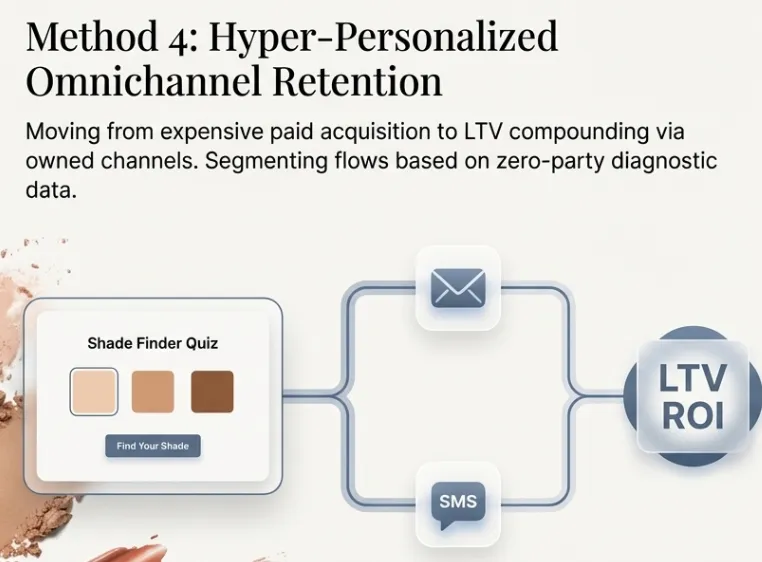
Most brands treat acquisition and retention as two different departments. In the new beauty blueprint, they are a single, continuous conversation. The goal is to move away from the "leaky bucket" of paid ads and toward a model where owned channels (Email and SMS) do the heavy lifting of driving revenue.
The Power of Zero-Party Segmentation
The "Shade Finder Quiz" or "Skin Diagnostic" isn't just a conversion tool; it’s a data goldmine. By capturing zero-party data—information the customer intentionally shares—brands can stop "blasting" their list and start "serving" their community.
Tailored Email Flows: If a customer takes a quiz and identifies as having "sensitive skin," their entire welcome sequence and product recommendations should reflect that. No more sending "heavy retinol" ads to someone with rosacea.
High-Intent SMS: SMS is the most intimate channel we have. By using diagnostic data, brands can send timely, relevant reminders—like a "Predictive Replenishment" text just as a customer is likely running out of their custom-matched foundation.
The ROI of the Relationship
When you segment your flows based on actual diagnostic data rather than just "last purchase," you stop being a nuisance and start being a resource. This shift creates a compounding effect on Lifetime Value (LTV).
The Retention Rule: A personalized SMS sent to a customer who feels "seen" by your brand has a significantly higher ROI than a cold ad shown to a stranger.
By utilizing these "owned" channels effectively, brands can ensure that the Next-Gen Growth Loop doesn't just spin—it accelerates, turning a single transaction into a years-long relationship with a high-margin ROI.
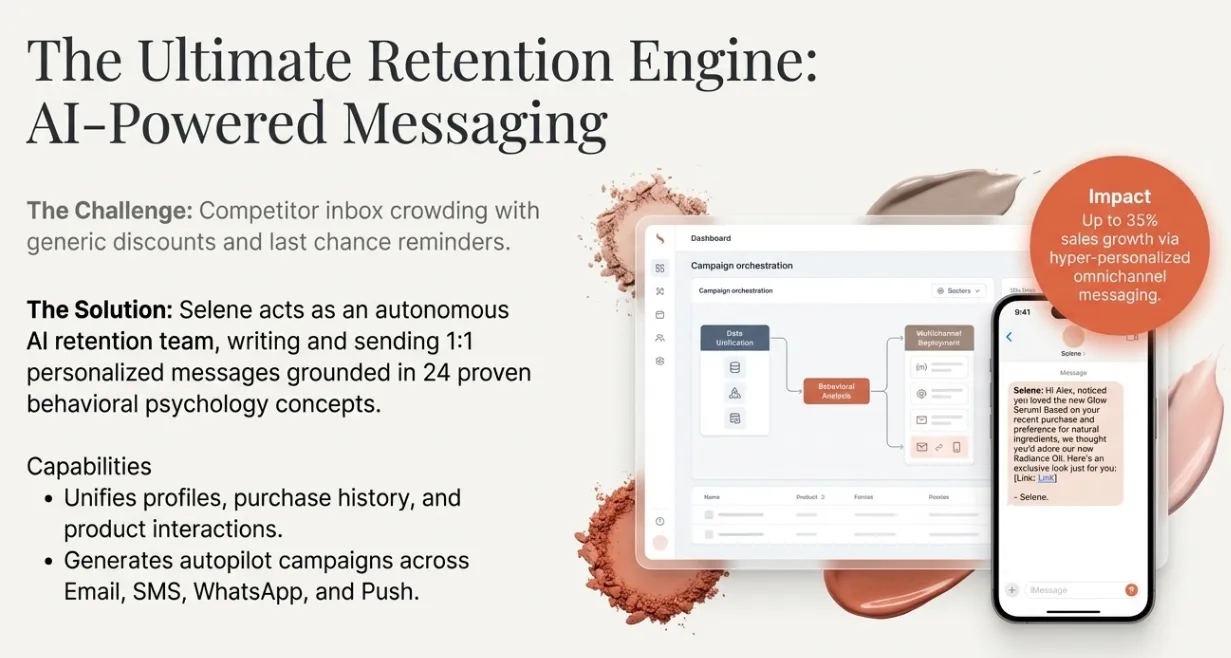
Grow Your Beauty E-Commerce Revenue by 30% with 1:1 Messaging.
For beauty brands, achieve 30% revenue growth by personalizing messages that turn one-time buyers into loyal subscribers.